

U.S. households love rewards programs. According to a 2025 survey by Deloitte, such programs not only drive loyalty and boost brand engagement but also increase perceived value, a sentiment shared by 80% of those polled.
Nuvision Federal Credit Union ($3.9B, Huntington Beach, CA) put a simple, cooperative spin on incentives with Added Advantage, a loyalty program the credit union rolled out in 2017.
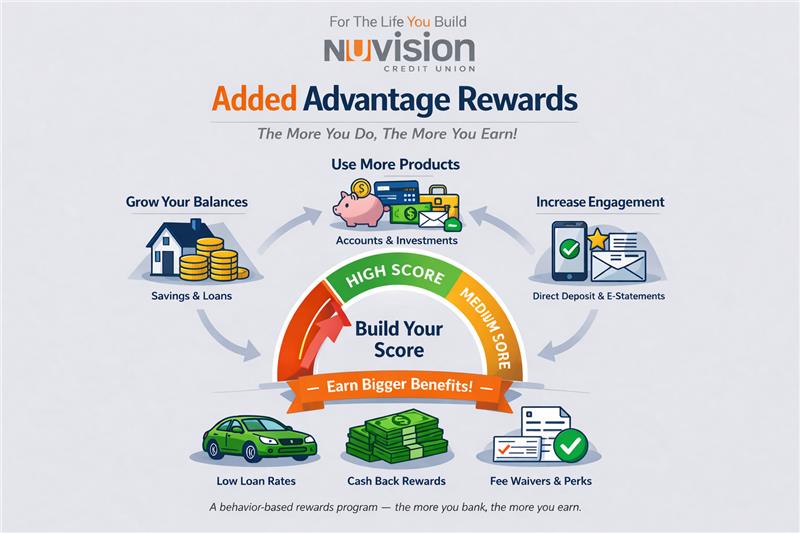
“Many financial institutions reward individual products, like a checking account or loan, but we wanted a program that recognizes the overall relationship,” says Tom Sweet, senior vice president of marketing for the credit union. “The more business a member does with Nuvision, the higher their score. The higher their score, the higher their benefits.”
What Do Members Really Want?
Sweet says Added Advantage emerged from Nuvision’s broader effort to evolve from a product-focused model to a relationship-based member experience.
Once the idea took shape, the credit union spent roughly a year to plan, model, and test the program before bringing it to market. During that time, teams worked on design as well as operational processes to support the program across digital and branch channels.
“One of the biggest challenges was designing a system that balanced simplicity for members with meaningful incentives for deeper engagement,” Sweet says. “Another challenge was operational readiness, ensuring our systems and staff training were aligned before launching the program broadly.”
CU QUICK FACTS
NUVISION FCU
HQ: Huntington Beach, CA
ASSETS: $3.9B
MEMBERS: 212,237
BRANCHES: 34
EMPLOYEES: 602
NET WORTH: 11.2%
ROA: 0.86%
Although Sweet and his team created the program, he describes its development as a continuous, multi-department effort.
“Executive leadership supported the strategic vision of the concept, whereas front-line teams provided important feedback on what members value and how the program would work in day-to-day member interactions,” he says. “We wanted the program to be easy to understand while still accurately reflecting the strength of a member’s relationship with the credit union. That required thoughtful modeling around scoring, benefits, and long-term sustainability.”
Since its introduction, adoption has been strong and steady.
“Members appreciate that the program is free to join and that benefits are tied to everyday banking activities they are already doing,” Sweet says.
Simplicity With Meaningful Incentives
When members opt-in they receive an Added Advantage score, which increases as they use more Nuvision products or services.
Cooperative Principles
Voluntary & Open Membership
Democratic Member Control
Member Economic Participation
Autonomy & Independence
Education, Training & Information
Cooperation Among Cooperatives
Concern For Community
Diversity, Equity & Inclusion
“It is similar to a FICO score that provides better rates with higher scores,” Sweet explains. “The more a member banks with Nuvision, such as maintaining deposits or financing loans, the higher their score becomes.”
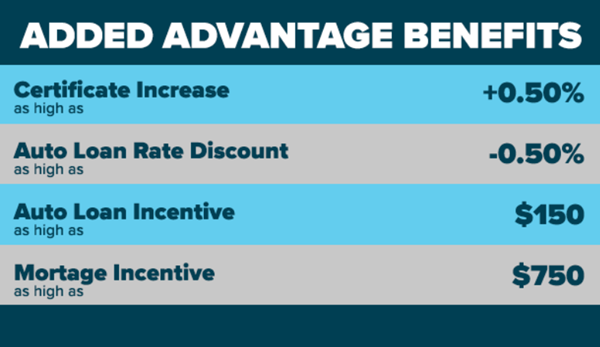
As the score increases, members unlock additional benefits, including lower loan rates, higher certificate interest rates, and cash-back incentives on loans.
The credit union combined digital communications and traditional marketing campaigns for the program’s rollout, although Sweet says support from branch and contact center teams is an essential part of the ongoing awareness strategy.
“Front-line employees were and continue to be key ambassadors for the program,” the SVP says. “They help members understand how the program works and identify opportunities to increase their score by expanding their relationship.”
Today, Nuvision measures success through a variety of key performance indicators, including enrollment and participation, growth in multi-product relationships, and deposit and loan balances.
“Ultimately, the most important measure is whether the program helps members deepen their relationship with Nuvision over time,” Sweet says.
As deposit and loan growth becomes more competitive, those deeper relationships can have a direct impact on balance sheets, not just member experience. For example, Nuvision’s asset growth accelerated notably in recent quarters to reach 18.48% in the fourth quarter of 2025. Meanwhile, loans grew 15.4%, more than double the 6.0% peer group average for credit unions of a similar size. Nuvision’s ability to sustain higher growth supports the idea that member engagement is strong.
Ditch The Gimmicks
Looking ahead, Sweet says Nuvision sees Added Advantage as a long-term platform rather than a static offer. It’s designed so the credit union can continuously enhance the program with new benefits and partnerships over time.
“As member behavior and financial needs evolve, the program can adapt to ensure rewards remain relevant and valuable,” Sweet says.
For credit unions seeking a similar program for membership, the marketing leader says to start with the member relationship, not the reward.
“The most successful loyalty programs aren’t about points or gimmicks,” he says. “They’re about encouraging behaviors that strengthen the relationship between members and the credit union.”
It’s also important to invest in member education early, especially when communicating the financial value the program offers.
“If members can easily understand the program and see the impact on their financial lives, adoption and engagement will follow naturally,” Sweet says.