
Credit union leaders from across the country once again converged on Washington, DC, this week for the annual Governmental Affairs Conference from America’s Credit Unions. The first full day of this year’s confab was chock-full of insights and learnings, including discussions on the future of credit union advocacy, CDFI matters, a keynote address from bestselling author Brene Brown, and more.
Read on for some of the day’s highlights.
Takeaway: New Faces, Same Defiant Attitude
This year’s GAC is America’s Credit Unions’ first with Scott Simpson at the helm, having succeeded longtime CEO Jim Nussle last year. From the outset, Simpson made it clear that he’s not here to play games.
His walk-up music? The ’80s hard rock anthem “We’re Not Gonna Take It,” by Twisted Sister.
Echoing today’s affordability crisis, Simpson noted Congress passed the Federal Credit Union Act nearly 100 years ago because “it was clear the masses of America were being left behind.”
“Credit unions are here because the government says we can be here — and it can be taken away,” he continued. “We have enemies with deep pockets and deep relationships, and they see credit unions as a threat to their bottom line.”
Eliminating the credit union tax exemption, he added, would eliminate a proven path to economic freedom.
The key, said Simpson, is to accelerate and amplify stories of how credit unions are making a difference in members’ lives. But they must couple that with rigorous advocacy.
The Member Story Project on CreditUnions.com. Join fellow credit unions in spotlighting the everyday moments that define the credit union movement. Add a member story to The Member Story Project and inspire others across the industry. Submit stories today.
“The strength of our political machinery is crucial,” he said. “To the administration, Congress, [and] regulators, we must make it crystal clear that credit unions are the answer to their calls for affordability. We are already here, we are already in the market, and we are already helping. We have the undeniable will of 145 million members who have chosen credit unions for their financial services, and that relationship carries brand equity that is the most powerful political weapon we have. Those 145 million members are the great equalizer when up against well-funded opponent.”
Takeaway: NCUA’s Hauptman Eyes The Future
The appearance of NCUA Chair Kyle Hauptman in a fireside chat with Simpson was notable for multiple reasons. First, he’s currently the only sitting member on the three-person National Credit Union Administration board — a scenario that hasn’t occurred in two decades. He’s also on the Public Company Accounting Oversight board.
With all of that on the table, Hauptman was quick to reassure credit unions he has no plans to leave until a successor is in place, as many NCUA board members frequently do. The administration has not announced a successor, but Hauptman said he expects that to happen sometime this year.
Hauptman joined the NCUA board in 2020 during President Trump’s first term and became chair at the start of Trump’s second term. He touted successes during his tenure, including increasing transparency and restructuring the agency. That restructuring, which he touched on during his 2025 GAC remarks, reduced NCUA’s headcount by more than 20% with buyouts intended to increase efficiency.
“We’re going to land the plane safely and do our job with only 77% or 78% of the people we did before; I think we’ve done a lot of good spring cleaning,” he said, adding that it’s rare to see such a large buyout and restructuring at government agencies.
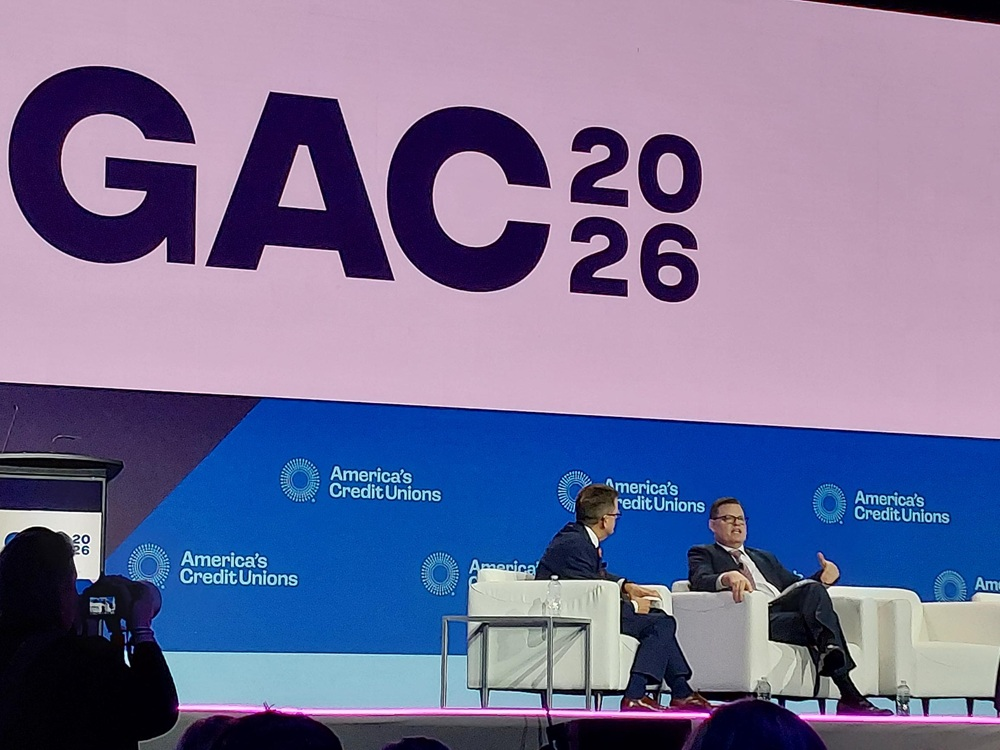
Hauptman has emphasized deregulation, echoing a broader push across federal agencies, and he touted the agency’s efforts on that front. Hauptman said the focus there has been on removing duplicative and obsolete requirements, such as one rule that required a specific font size on all documents, modifying examination requirements and timelines for well-capitalized institutions, and more.
The conversation also turned to digital assets, including stablecoins. Hauptman said he was particularly proud of the fact that, “for a while we were the only regulator that wasn’t openly abusive to digital assets and blockchain — we were in favor of it,” and that the agency never provided counterproductive guidance on the issue that it need to repeal. He called stablecoins “the ultimate use case” for consumers skeptical about cryptocurrency and emphasized his belief that this technology is simply a modern approach to money management.
“The core of banking hasn’t changed in thousands of years,” he said. “This is just the latest iteration of services.”
Although there has been some concern regarding potential attempts to fold NCUA into other banking regulators, Hauptman attempted to assuage those fears.
“Congress says it’s a three-member board,” he said. “There will at some point be one, and then two, and then three.”
Takeaway: Don’t Be Netflix, Be Doordash.
Credit unions have long looked to tech firms like Amazon and Netflix as a model for how to serve younger consumers, but there might be a better model.
“There’s a whole generation that will pay out the nose for Doordash,” Jeremy Pinard, chief lending officer at Canvas Credit Union ($4.9B, Lone Tree, CO) and chair of the America’s Credit Unions Lending Council, said during a Councils panel discussion. “We’ve got to change our thinking on how we serve that next generation.”
Clifton Van Scyoc, chair of the information and tech council and chief information officer at Pennsylvania State Employees Credit Union ($8.9B, Harrisburg, PA), followed that up with some statistics:
- Fees and tips add 39% to the average Doordash order.
- 85% of Doordash users are age 44 and younger.
- 40% of those consumers use the service on a weekly basis.
“Cost isn’t relevant,” he said. “They’re doing it for convenience. “
And there are real implications here from a balance sheet perspective, said Christine Messer, chair of the finance council and CFO at Heritage Family Federal Credit Union ($812.3M, Rutland, VT). Household are willing to pay for something they need or that provides value. That can make a measurable difference when it comes to non-interest income.