
This article is part of Callahan & Associates’ “CDFI Grants In Action,” a limited editorial series that showcases how credit unions leverage CDFI funding to advance their mission and deliver measurable impact for members. To learn how CDFI certification can change lives and unlock opportunities at your credit union, visit CU Strategic Planning, A Callahan Company.
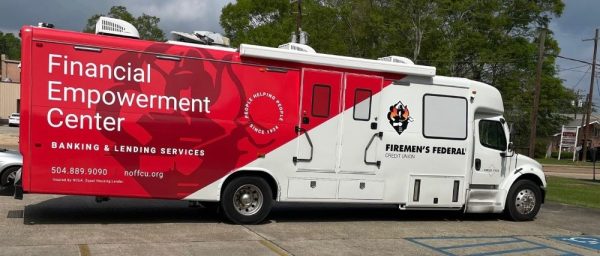
When hurricanes rip through the Gulf, they leave behind disrupted lives and disconnected communities. In those moments, access matters as much as empathy. When disaster strikes, The New Orleans Firemen’s Federal Credit Union ($275.0M, Metarie, LA) is ready to roll with a mobile branch that brings back banking to the front line of recovery.
The Problem

A dozen hurricanes have impacted Louisiana or made landfall there since the year 2000, according to NOAA data. FEMA’s National Risk Index classifies New Orleans and its environs as being at high risk for hurricanes and with high levels of social vulnerability, although the area also rates highly for resilience.
“As we observe the 20th anniversary of Hurricane Katrina, it’s not if it’s going to happen again, it’s when,” says James Hunter, the cooperative’s chief advocacy and culture officer. “When disaster hits, things shut down. People don’t have access to energy, to gas, to cash — anything you take for granted, we don’t have anymore.”
As an institution serving low-income, underbanked, and overlooked communities, the credit union wanted a way to ensure it was accessible in the worst of circumstances.
The Solution
With storms an ever-present threat, the credit union used a CDFI grant to shore up its capital position, in turn creating the flexibility needed to free up approximately $170,000 for a mobile branch, says President & CEO Judy Delucca.
The result is a full-scale branch on wheels. Just one foot shy of a commercial truck, it includes a computer and ATM access, cash on hand, a generator, and more. It’s a way to serve communities that don’t have access to banking services due to storm damage or other factors.
“We’re trying to fill a void,” Hunter says. “We’d love to be able to mobilize anytime to reach communities. Cash is king in these times. If you don’t have cash, you don’t have anything.”
What’s Next
New Orleans Firemen’s isn’t waiting for disaster to strike; it’s got plans to fill accessibility gaps in other ways.
“This is probably the most downtime we’ve had for disasters in a long time,” Hunter says. “We haven’t had a chance to show it in its full form, but we’re looking at different ways to use it.”
For example, the credit union’s community advisory team has pinpointed accessibility as a major issue in the region, particularly in pockets of Louisiana and Mississippi where many people lack access to reliable vehicles or live in banking deserts. Hunter says the credit union is working to schedule times to take the mobile unit into those spaces.
Also on the table are potential partnerships with local farmers to provide a fresh-food initiative for community members who live in food deserts. New Orleans Firemen’s also is working with Feed The Second Line, which has hubs ready for when disaster strikes. The credit union is discussing how to partner with that local community agency to provide access to financial services when consumers need them most.
Of course, it doesn’t have to be a top-tier disaster to bring out the branch. Even something like power outages from thunderstorms are reason enough to spring into action, Hunter says. The credit union knows it can be anywhere within a given radius quickly and is trying to be thoughtful about how and when it deploys the branch.
“These are all creative ways we can use that vehicle as an opportunity to serve our community,” Hunter says.
And when the next big storm hits, New Orleans Firemen’s is ready.
“If you’ve ever seen on TV what happens after a hurricane, it doesn’t do it any kind of justice,” Hunter says. “We’re talking about big trees blocking roads, powerlines on the ground, nobody can get gas — it’s a cash-only environment. The fact that we’re now ready for those things and able to reach out to certain areas changes how we can be more impactful.”
