
Top-Level Takeaways
- Research, and early results from Harbor Beach Community Schools, show that small, early deposits can meaningfully influence whether students save for life after high school.
- In Harbor Beach, the local school system, a community foundation, and Frankenmuth Credit Union share ownership of CSA outcomes, with Frankenmuth positioned as an active partner, not just a place to park funds.
- For Frankenmuth, the return isn’t immediate balance‑sheet lift but the possibility that a single early relationship becomes a lifelong one.
For many students, the path after high school is shaped more by affordability than ambition. This applies to both college and trade school programs.
Research suggests it doesn’t take much to improve that trajectory. A University of Kansas study found students from moderate- and low-income families who had saved up to $500 were three times more likely than their peers to enroll in a post-secondary program.
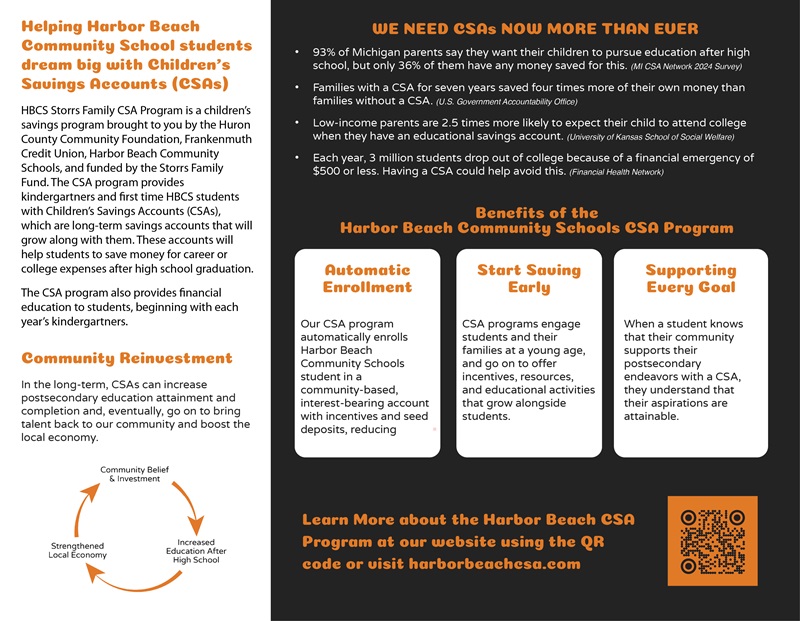
In Michigan, a public-private partnership between the Huron County Community Foundation, Harbor Beach Community Schools, and Frankenmuth Credit Union ($1.5B, Frankenmuth, MI) is helping every kindergartener and first-time student in Harbor Beach Community Schools build a savings for post-high school plans.

“To have that little nudge to take that next step, bet on yourself, and maybe give yourself a different set of circumstances — the credit union could definitely get behind that,” says Jacob Purman, who was at that time the community development coordinator leading the effort on behalf of the credit union.
Launched in January 2025, the Harbor Beach Community Schools Storrs Family Children’s Savings Accounts Program provides every student with a $100 starting deposit plus smaller deposits every year thereafter. Parents, students, and community members have the option to make additional contributions at any time. Upon graduation, students can withdraw their balance to put toward college, trade school, work equipment, or other post-high school ambitions.
As of December 2025, 592 of these accounts held more than $75,000 total. With only two opt-outs, the program touts 99% participation.
A Partner, Not A Place To Park Cash
Although the program launched in 2025, its roots date back to 1951. That’s when a local woman named Lorraine Storrs graduated from Harbor Beach. She believed deeply in her community and the role of education. A $553,000 gift from the Storrs’s estate in 2024 established the Storrs Family Fund. From there, the school district partnered with the Huron County Community Foundation to create a permanent endowment and child savings account model for every student — present and future.
That’s when Frankenmuth Credit Union submitted a proposal to become the program’s financial partner.
“They didn’t just want somebody who was going to handle the accounts,” Purman says. “Theoretically, any financial institution can find a way to make it work. They wanted to go above and beyond.”
The credit union was already hosting reality fairs for high school students, and it had opened a branch in Harbor Beach in 2024. As financial partner, Frankenmuth built financial education into the CSA program’s infrastructure. Today, every Harbor Beach Community Schools teacher has access to the online platform Banzai, which includes courses, calculators, articles, and printable materials. Credit union staffers provide in-person classroom presentations, and the credit union still hosts reality fairs bi-annually for juniors and seniors.
Flexibility Is Essential
HBCS STORRS FAMILY CSA PROGRAM
Funding Breakdown
- Original donation: $553,000.
- Endowment and long-term funding: $500,000.
- Initial student deposits: $53,000.
Program Structure
- First-year deposit: $100 per student.
- Annual contribution: $30 via interest.
To provide the child savings accounts, Frankenmuth design a brand-new product that required new workflows, manual processes, and ongoing coordination with compliance.
“If we weren’t flexible, this wouldn’t have worked at all,” Purman says. “We went into it with open ears, listening to the wishes of the school and the Community Foundation. Then, we got creative to find a way to make it work.”
The end result? A custom, hybrid CD savings model. The endowment deposits $100 for first-year students and then contributes $30 each year after for returning students; plus, accountholders earn interest on the balance. Students pay no fees or minimum balances to maintain the account; however, they cannot access the funds until after high school. If a student leaves the district, their account remains open and they can access the funds after graduation, but they do not receive additional contributions during the years they are no longer in the district. Following graduation, all student accountholders must submit a request for the funds. And when it comes to those annual deposits from the endowment, the program’s founding documents allow the partners to increase contributions over time as the endowment grows.
“If there’s more interest funds to contribute a higher amount, they have the freedom to up that,” Purman says.
For now, the program partners decided the initial deposit of $100 was meaningful but also preserved long-term sustainability.
“They wanted it to be enough that it felt like it was something,” Purman adds. “$100 felt like a good starting point. One hundred dollars is something to everybody.”
Students, families, and community members can make additional contributions at any time by visiting Frankenmuth’s Harbor Beach branch. Making a deposit requires only knowing a student’s name and grade.
Purpose Over Profit
For students who can’t make it to a branch, Frankenmuth and Harbor Beach Community Schools also host in-person Deposit Days on campuses twice a year.
“On the very first deposit day, there was a young man who had some pocket change he was counting,” Purman says. “The superintendent saw him, got a couple bucks out of his own wallet, and told us to put that in the student’s account, too. It wasn’t a significant contribution, but I thought that was a neat gesture.”
That first event in January 2025 generated $116.87 in CSA savings. The most recent deposit day totaled $2,536.
“It started with kids saying, ‘Hey, I’ve got a nickel in my pocket,’ and now we’re seeing much more meaningful participation,” Purman says. “There are a couple of things happening that show the program is taking hold in the community.”
For example, program leaders have scheduled a deposit day to coincide with a Grandparents’ Day in April to encourage multigenerational involvement. Program leaders are also talking with local businesses, encouraging them to contribute small amounts to student accounts. Over time, leaders hope the program will continue to bring people together to invest in Harbor Beach’s next generation.
So far, multiple students have opened personal accounts through Frankenmuth alongside their CSA. According to Purman, because this program is primarily purpose-driven, not balance-sheet-driven, it’s difficult to quantify program-related growth and activity. However, that doesn’t mean there’s not a clear return.
“You don’t know if people do their other banking with us because of doing something like this, but you don’t have to go far for the ROI to be there,” he says. “I always tell people that if we have just one student who ends up doing their banking with us for life, if one good relationship comes from it, that’s enough to cover it.”