
Top-Level Takeaways
- Technology increasingly shapes the employee experience, making closer alignment between IT and HR a strategic advantage.
- The chief people and technology officer role at Vantage West Credit Union reframes HR systems around employees, not administration.
- Organizational design should reflect talent, not tradition.
The path to head of human resources is rarely paved with a career in technology. Rob Hoyle is proud to be an exception.
After spending most of his career outside financial services, Hoyle found his way to the credit union industry in 2018, taking the role of chief information officer at Credit Union of America. He says he immediately identified with credit unions’ people-first mission.
“I am a leader who’s empathetic and wants to help people thrive,” Hoyle explains. “I’m a huge culture champion. I genuinely care about the success of the organization and the individuals that make up the team.”
Hoyle joined Vantage West Credit Union ($3.3B, Tucson, AZ) as its chief information officer in 2021and has served as the credit union’s chief people and technology officer since June 2025.
What’s the story behind your title?
RH: Our senior vice president of human resources was retiring, and I told the CEO I’d like to take a shot at human resources. I pointed to one of my first initiatives at Vantage West, which was introduce a management and employee engagement platform. There’s never really great collaboration between technology and HR. We spend so much time on the member experience through technology, we need to create a great team member experience, too.
How would you describe your job duties? What falls under the umbrella of technology and human resources at Vantage West?
RH: I’m so incredibly fortunate to lead teams that are highly engaged and full of tremendously skilled professionals.
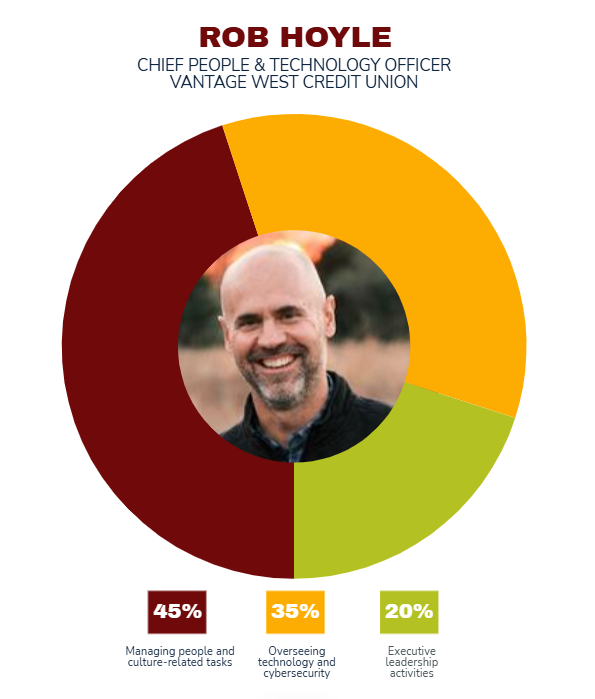
On the technology side, it’s all of IT — information security, application development, data, systems, networks, all of that. On the human resources side, it includes traditional HR, organizational development, facilities, and physical security. I also have accountability for mergers and acquisitions. We’re not doing anything right now, but in terms of prospecting, diligence, and integration, I would lead that effort if something came across our desks.
When you interact with others in the industry, are there misconceptions about what your role means?
RH: I don’t think there are misconceptions so much as raised eyebrows. There’s a unicorn in my LinkedIn bio for a reason.
Even internally, people have asked, “Why would you give human resources to the technology leader?” I’m working on helping people understand that I’m not just the technology leader. I’m the chief people leader. I’m both. Every time it comes up, people stop, read it twice, and say, “Wait, what?”
From the application process onward, technology influences how people decide whether they want to work with you.
What part of your role energizes you the most? Conversely, what challenges you the most?
RH: The challenges are where the energy comes from. I enjoy solving problems and making things better. The biggest challenge has been learning everything HR entails. It’s far more complicated than people realize if they’ve never been behind that curtain. There are so many considerations for every decision.
That’s also what energizes me. Very few HR leaders have ever been customers of HR. I bring that perspective and ask why we do things in a certain way. Sometimes, I wonder if the team is thinking, “Here comes Rob with another crazy idea.” But they’ve been very receptive and open to either explaining or rethinking things.
What’s an experience or accomplishment that stands out as especially rewarding or meaningful to you?
RH: One of the most impactful things we’ve done since the role change is rethinking our organizational development philosophy. We used to be very prescriptive with specific programs, nomination processes, and assumptions about who should attend what. One of the first things I questioned was why. Why those programs? Why not more autonomy?
Now, for external professional development, leaders have a blank canvas. We focus on the people who need development and find opportunities that fit them. If someone’s in finance, maybe it’s a finance-specific training instead of a credit union one.
If everyone goes to the same training, everyone learns the same things. We’re looking for diversity of thought and experience and more meaningful development for individuals.
How do you define success in your role? Beyond metrics and formal accountability, what tells you you’re doing the job well?
RH: I feel successful when other people achieve their goals, whether that’s professional development or personal milestones. I love seeing someone graduate, earn a degree, or be recognized for something.
We recently migrated our phone system, and nothing went wrong. I didn’t touch a single keystroke. I sponsored it and was accountable for it, but the team owned it and executed it flawlessly. That’s success to me — having a team that can get things done and do it well. There’s no KPI for that. It’s a feeling.
Is there anything you’re particularly excited about or looking forward to in 2026?
RH: Every year, I bring my entire organization together for a half-day event. For years, the team asked for more involvement. We increased it a little each year.
Last year, we brought in Tucson Improv. We turned the involvement up to 11. Some of our team members aren’t the biggest fans of public speaking, so there were some very nervous faces, but it was universally well-received.
Engagement afterward was through the roof. Watching the team stretch, learn, come together, and have fun is incredibly fulfilling for me. So, what I’m most excited about in 2026 is figuring out how in the world I’m going to top that.
What would make you tell another credit union that a role like this — or at least deeper collaboration between technology and HR — is worth considering?
RH: Executive org charts should reflect the talent you have.
That said, there is tremendous value in understanding how technology shapes the employee experience. No one says, “I love working in my HRIS.” These systems are designed for HR departments, not employees. From the application process onward, technology influences how people decide whether they want to work with you. Are you asking them to fax something? Can your system read a résumé, or do they have to type everything in again?
Our people are our greatest asset. We need to equip them with every advantage possible, and many of those advantages are technology-based.
Too often, HR and technology operate in silos, sometimes speaking completely different languages. The goal is collaboration, understanding, and designing systems that make people’s lives better.
This interview has been edited and condensed.
Job titles say as much about the organization as they do the person. “What’s In A Name” on CreditUnions.com dives into notable, important, interesting, or just plain fun roles to find out what’s happening at the ground level and across the industry. Read the series today.