
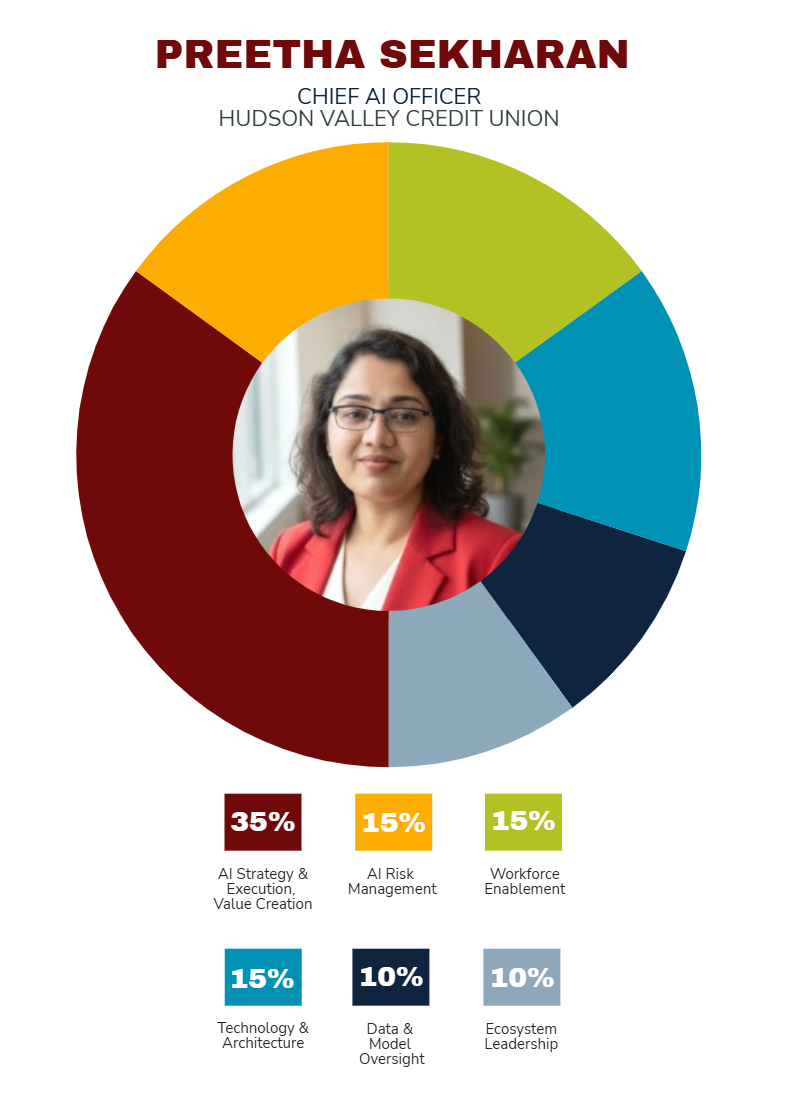
People think this is a technical role. What I’ve learned is that for this to be successful, whoever is leading it needs to have the right balance between strategy and execution, business and technology, and risk and innovation.
Preetha Sekharan, chief AI officer at Hudson Valley Credit Union ($8.1B, Poughkeepsie, NY) is poised to have a very big influence very fast.
Not bad for someone who’s only been in the industry for a couple of months.
Sekharan’s background is in software engineering, with previous experiences in healthcare management consulting and leading innovation & AI in the insurance industry. Hudson Valley is her first credit union post.
Only a few credit unions nationwide have a C-level role dedicated to AI strategy and adoption. At Hudson Valley, Sekharan is helping the New York‑based cooperative rethink how it approaches the technology and what it chooses to prioritize.
What is your elevator pitch when someone asks what you do?
Preetha Sekharan: I lead how AI is applied in transforming our member experience and driving growth, efficiency, and better risk management. Innovating at the right pace — meeting our regulatory and responsible standards.
Why is this title important?
PS: It signifies we’re serious about AI and it’s a strategic capability. It’s less about the title and more about the message that it sends internally and externally. It means there’s more accountability around AI. It’s no longer something we experiment with; it’s something we expect real business value out of.
As we start scaling AI efforts across the organization, there’s a need to have executive ownership — someone who ensures we are deliberate about where we use AI, how fast we move, and how we protect member trust while doing it.
What makes your role interesting?
PS: If I track my own journey, there are a few things that matter to me: Am I learning? Am I driving business impact? This role has both to a high degree.
It’s also a role that sits at the intersection between strategy and execution, business and technology.
What part of your role energizes you? Conversely, what part challenges you the most?
PS: A lot of things are challenging. People are discovering new capabilities every day as technology is evolving fast. I’ve been in the tech space for a while now and it has never been this overwhelming. Driving real impact isn’t easy – a lot of it is about people and changing behaviors, not just technology.
What challenges me also energizes me. We are charting new paths, given the pace of innovation in the AI space. I had to learn and unlearn a lot of things when I pivoted to AI from software engineering.
You have to apply first principles thinking to assess “How do I solve this problem?” because you might not have a lot of references of how it has worked before in 500 other organizations. That, to me, is very energizing.
What’s the biggest misconception about your role?
PS: The biggest misconception is that this is a purely technical role or one that can be filled by simply elevating a technologist or data scientist. In reality, successful AI leadership is far more multi‑dimensional.
What I have learned is that an AI leader needs to balance strategy and execution, business and technology and risk and innovation. It’s not purely a technical role. It is as much about people, change management, and culture as it is about models and platforms.
There’s also misconceptions around governance in general. At the credit union, we’re trying to stand up AI risk management and governance, before we go mainstream with many use cases. The moment people hear “AI governance,” the first thought that comes into their mind is, “Oh, this is going to slow me down.” Done right, governance does not slow innovation; it should help accelerate innovation.
CU QUICK FACTS
HUDSON VALLEY CREDIT UNION
HQ: Poughkeepsie, NY
ASSETS: $8.1B
MEMBERS: 388,883
BRANCHES: 37
EMPLOYEES: 1,105
NET WORTH: 10.5%
ROA: 0.20%
What is the No. 1 skill you need to do your job?
PS: Instincts and judgment — being very intentional about what you say no to and what you say yes to.
There’s a lot of hype and there are zillions of startups and companies that did not exist two or three years back that are now available in the market, so the ability to quickly discern what is hype versus what is ripe for use cases is crucial. It’s a judgement skill.
AI also is about trust, influencing stakeholders and bringing an organization along. Your ability to do that is critical for this role.
Is that a skill where you’re pretty strong?
PS: I’m a work in progress.
What skill do you wish you had or had more of for your job?
PS: Influence at scale and trust. Trust is not built in a day. When you’re new to an organization, that takes effort — being intentional and understanding that when you bring people along it may be slow at first, but eventually it’ll get faster.
How does your role contribute to the success of the credit union in ways people might not expect?
PS: AI tends to put the spotlight on weak areas in your organization. Maybe your data is not in good shape, you don’t have standard processes, or there’s a lack of clarity around how decisions are made. You have to get it right and make it right before you can scale AI.
How do you define success in your role?
PS: The first definition of success is achieving the business value. That’s the No. 1 priority.
We’re still defining what the strategy is and the North Star vision for AI in the credit union. As we define that and clearly lay out the metrics and goals we have around various business aspects, whether it’s member experience or employee experience, achieving that goal in the short term and keeping sight of the longer-term impact is the priority.
We’re also building the capability of AI within the organization. That’s priority No. 2. I’m spending a good bit of time standing up AI governance and building that muscle around risk, AI risk, and risk management. It’s about making sure we balance governance, not overengineer it, with innovation. That’s goal No. 3.
At the end of the day, this is a lot more about people than it is about technology, and we have to make sure our employees also feel that way.
If your role didn’t exist, what would your credit union be missing?
PS: The credit union was doing AI projects before I came, so there have been pockets of places where we’ve executed on AI. The biggest value I bring is in direction and coherence. That’s something I expect my role to bring forward. I almost see my role as a force multiplier. If 1+1 would have been two without me, 1 + 1 should be 11 with me.
What makes a credit union need this role?
PS: It depends on what you want to do with AI in your organization. If you think this is going to be a strategic capability, you’re better off having a role that is focused on driving that.
You either have the scale for this capability and drive a lot of value for your business, or you are on the cusp of a growth spurt where bringing in these capabilities could unlock that capacity for growth. Without this role, there might be small use cases fragmented across the enterprise, but the organization is not really thinking about AI in a strategic and consistent way driving real business impact.
What else do you want people to know about your role?
PS: AI is evolving and trust is an important part of the equation for a successful AI transformation. I expect this role to build both; the more you build adoption of AI, you also build that trust, which compounds over the years.
What (other) roles do you see driving credit unions forward in a modern financial services environment?
PS: A product mindset is important because we think of AI assets as living beings — they have a lifespan, they drift and you need to make sure you’re managing these assets over the course of their lifecycle. So AI product managers will be an important role. Also, change management roles – people focused on operations, processes, and people. Thinking about ways to reimagine value streams with AI embedded. Making sure people are equipped and trained to support that.
I also see that any organization that is serious about AI will need to build the AI risk and compliance muscle.
This interview has been edited and condensed.
Job titles say as much about the organization as they do the person. “What’s In A Name” on CreditUnions.com dives into notable, important, interesting, or just plain fun roles to find out what’s happening at the ground level and across the industry. Read the series today.