
Top-Level Takeaways
- Marine Credit Union thoughtfully embedded its foundation into its own strategic plan, aligning both around a shared community focus.
- Integrating programs, resources, and employees has made the foundation an extension of the credit union.
- Governance, shared leadership, and deliberate communication also ensures alignment across day-to-day operations.
Marine Credit Union ($1.1B, La Crosse, WI) doesn’t lack commitment to community impact. It stood up its Marine Credit Union Foundation in 2013 to address issues like financial education, food security, and affordable housing — systemic challenges that have no quick solutions. Despite it’s good work, there were opportunities to further align it’s work with the credit union’s overall strategy.
“We had been doing a lot of great work in the community, but it wasn’t always connected back to the broader strategic priorities of the credit union,” says Joumana Mcdad, chief service delivery and experience officer at Marine Credit Union. “It felt like separate efforts that were sometimes competing with each other, whether for staffing resources or marketing support.”

So, the Wisconsin cooperative and its charitable arm embarked on a year-long journey to redefine how each interacts with the another. With alignment and integration, the foundation shifted from being a stand-alone effort to a built-in contributor to credit union strategy.
“At Marine, we operate under a three-stakeholder model: When we prioritize the well-being of our employees, we create a culture where people feel valued and supported. That care naturally extends to how our employees serve our members with compassion, empathy, and excellence, and when our members are well-served, the communities that we serve grow stronger and more resilient,” Mcdad says.
Purpose-driven growth that’s built to last. In Callahan’s Strategic Growth Framework, Jon Jeffreys lays out a powerful model for credit union success — one that weaves purpose into every step. Engage employees. Amplify member impact. Sustain momentum. This isn’t just a blueprint; it’s a call to action for leaders ready to turn potential into progress. Request your complimentary copy today.
The Power Of An Outside Perspective
When making this strategic shift, the duo did not act alone.
Mcdad, her team, the Board, and Executive team tapped an outside consultant to conduct a full foundation assessment. This included everything from bylaws, policies, and procedures to the organization’s management agreement, especially when it came to how the credit union supported the foundation through in-kind resources. The evaluation also included advice related to programs, budget, and grant opportunities.
“Once we had that assessment, we took those recommendations and distributed them across our executive and leadership teams,” Mcdad says. “That helped everyone feel ownership. They weren’t just observing the change. They were actively helping build it.”
Looking back, Mcdad notes this was especially important because it allowed leaders to make decisions with greater objectivity. The team reworked the board structure and made sure the foundation was clearly aligned with the broader credit union.
“We embedded the foundation into the credit union strategic plan and defined where it fits within the overall strategy,” Mcdad says.
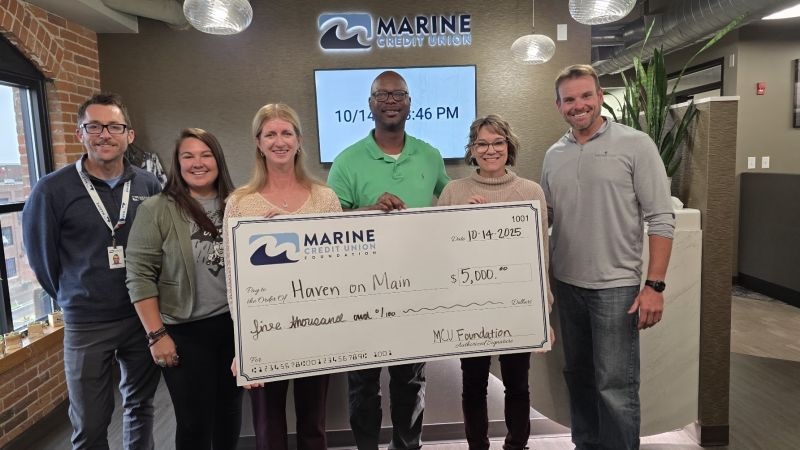
Structure, Governance, And Shared Ownership
The foundation’s early model was anchored by a dedicated board of community volunteers, with limited direct involvement from credit union leadership beyond a liaison role served by Mcdad. Credit union staff supported volunteer and community efforts, while board governance remained primarily community led. As board terms expired, leadership used the transition as an opportunity to realign governance more closely with the credit union.
Mcdad now serves as board chair, leveraging her role overseeing community engagement, members, and branches for the credit union. Marine Credit Union’s CEO, Tom Knothe, serves as vice chair. But these aren’t the only two credit union representatives.
“Where we really started to get smart was in bringing on a Marine Credit Union board member to also serve on the foundation board,” Mcdad says. “She acts as a liaison at the board level, and that’s where we started to see stronger alignment take shape.”
The credit union’s vice president of community leads day-to-day operations for the foundation and functions as it’s executive director. Two credit union middle managers round out the foundation board as treasurer and secretary.
These key personnel changes didn’t just align the foundation with the credit union on paper, they ensured the foundation had an org chart to support the credit union’s strategy.
In addition to the newly established alignment, leaders also had to ensure they built buy-in at all levels of both organizations.
“The biggest lesson was the importance of over-communicating and making sure everyone feels part of the process, which means involving the right stakeholders early,” Mcdad says. “Alignment in isolation doesn’t work. You need input across the organization, and you need people to feel ownership in bringing the strategy to life.”
In practice, this means a lot of meetings. The executive and middle management connects frequently, and organization-wide updates are shared during monthly town halls.
“We want employees to feel embedded in the foundation and connected to its mission,” Mcdad says. “The best way to do that is to make them part of the vision and part of the decision-making.”
Open communication is one way the credit union brings in employees. Another way is through employee giving. It introduces employees to the Marine Credit Union Foundation during onboarding and allows employees to contribute any amount through payroll deductions, which the credit union matches at a 2:1 rate. It then pools the funds and redistributes them across the organization for departments to use as charitable budgets.
“Our branches and teams are closest to their communities,” Mcdad says. “They know the needs and the organizations. Why not let them be part of that impact?”
From Alignment To Action
After aligning strategy, organizational structure, and employee support, leaders then ensured the foundation’s programs connected directly to credit union products and services.
By The Numbers
Marine Credit Union Foundation
160+ financial education sessions (2025).
~$2M+ in philanthropic giving.
~$970K in employee contributions.
1,800+ causes supported.
For example, Marine Credit Union identified fragmentation within its financial education efforts. To address this, the organization hired a financial education director who oversee efforts like the foundation’s Finding HOME program, a free, 12- to 18-month program designed for individuals facing barriers to homeownership.
“By the end of the program, we typically see significant improvements in credit scores and savings and ultimately, we’re able to make a mortgage through Marine Credit Union,” Mcdad explains. “That’s where the alignment comes to life.”
So far, 39 program graduates have achieved homeownership. On average, participants reduce debt by approximately $12,000 annually and increase their credit scores by roughly 90 points.
By focusing on alignment, Marine can now look ahead to helping more people than before.
“In the past, because of resource constraints and the disconnect between the foundation and credit union, we couldn’t expand the program across all our markets,” Mcdad says. “Now that resources are aligned, we’re able to scale it much more effectively.”
From Siloed To A Strategic Lever
Today, the Marine Credit Union Foundation plays an essential role in the credit union’s community support efforts.
“If you put the community at the center of everything you’re doing, the foundation becomes a key lever,” Mcdad says. “Our credit union’s community team is out in the market building relationships and partnerships. Then, the foundation comes in as part of that conversation, supporting those partners through homeownership programs, financial education, and charitable contributions.”
Mcdad describes the next phase as deepening the foundation’s presence in the community and broadening its financial education efforts. Marine Credit Union is also focusing on how to continue to position the foundation as an extension of the credit union’s identity rather than an aside.
“It can be a real differentiator for credit unions,” Mcdad says. “If you build strong programs within your foundation, especially ones that are unique or highly impactful, you can use that as part of your broader brand. Not everyone has something like this. If you get good at one or two things, that becomes part of how your credit union stands out.”