It’s like we put all these awesome ingredients in the oven and the cake is starting to rise. I think it’s gonna taste pretty good when it comes out fully baked.
Dave Widener had two dreams as a kid: to make maps and live in Maine. Flash forward a few decades and, in a roundabout way, he’s doing both.
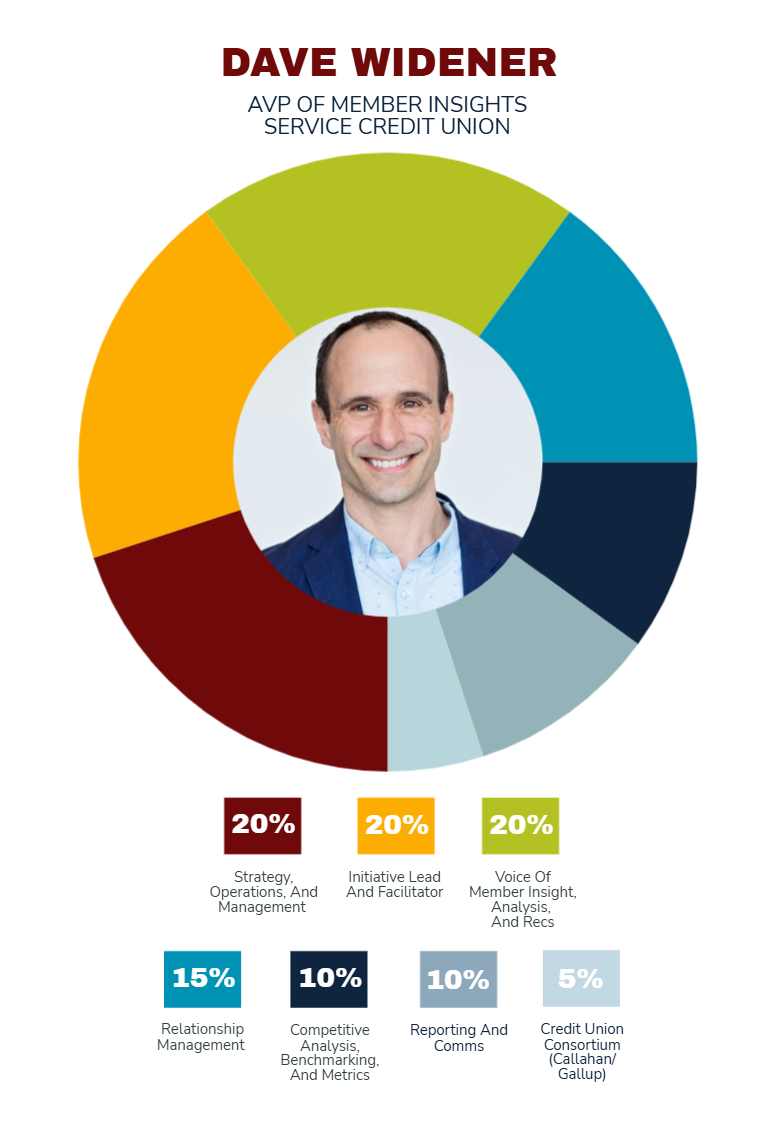
As a kid growing up in Ohio, Widener loved maps and dreamed of living in Maine. After college he worked briefly with legendary mapmakers Rand McNally. Today, he lives in Portland, Maine, and commutes into New Hampshire for Service Credit Union ($6.5B, Portsmouth, NH). There, he serves as assistant vice president of member insights, overseeing strategy management and the organization’s member-engagement program.
Put another way, he’s designing member experience maps to help the credit union reach its long-term goals.
Widener spent his career up until 2022 largely in IT and project management, but he’s a full convert to the credit union cause today.
“I wish I had found the credit union movement earlier in my career,” he says. “I’ve never felt more passionate about what I’m doing.”
What is your elevator pitch when someone asks what you do?
Dave Widener: I make sure what we’re doing is focused not just on our sustainable growth, but on the best outcome for our members. It’s almost the triple bottom line of doing well by doing good. That’s the credit union model, the more we do well for our members, the better we do.
What’s the story behind your title?
DW: I came from IT, I have a project-management background, and I was a business analyst at one point, so understanding processes and how to build alignment and shared purpose really came to bear here. I’ve always had a strategic mindset, so when Michael [Dvorak, CFO] said, “I want to build this function with you helping lead it,” I couldn’t say no.
What makes your role interesting?
DW: We needed some way to centralize what we’re doing with strategy, and although we’ve got more work to do, I see so much more purpose and alignment than we had before. Even though it can feel messy, we’re becoming that unified team we always knew we could be.
It’s like we put all these awesome ingredients in the oven and the cake is starting to rise. I think it’s gonna taste pretty good when it comes out fully baked.
What part of your role energizes you?
DW: I love a good problem to solve. Over my career I’ve been given things that couldn’t be fixed and I’ve fixed them, so I’ve never run from those challenges. I see these construction signs on the way to work that say, “Bridge work in progress,” and that’s what we’re doing — we’re creating bridges to the future and bridges between people and processes and member experience. Once these bridges are built, folks are walking across them and using them, and that’s when the engagement really starts.
What part challenges you the most?
DW: Historically we’ve been an organization whose heart has been in the right place. We love saying yes to things but then not understanding, respectfully, the difficulty of making them stick. I think a lot of folks saw the strategy office like this, so the winds were definitely against us. Year One was not easy.
Now we’ve brought in our chiefs as our steering committee, which has created this resurgence of belief. What we’re seeing now is this doesn’t need to be the latest flavor of the day. This can be something that sustains us into the future. The model is sound, the results are sound, and we have fantastic human potential we are beginning to powerfully capitalize on.
What did it take to get buy-in and start things moving in the right direction?
CU QUICK FACTS
SERVICE FEDERAL CREDIT UNION
HQ: Portsmouth, NH
ASSETS: $6.5B
MEMBERS: 380,457
BRANCHES: 52
EMPLOYEES: 943
NET WORTH: 11.8%
ROA: 1.10%
DW: It doesn’t matter what role they play, the more folks who can take on a role and see their work contributes to a metric that leads up to our team performance goals, the better we get. We’re creating successes, so folks on the sideline can say, “I want to be part of that team.”
What’s the biggest misconception about your role?
DW: Strategy isn’t one person’s role. If you’re the bridge builder and the dot connector, that’s a key role of strategy. But strategy belongs to everybody, just like the member journey and experience belongs to everybody. One person can’t represent that, but one person can help create movement and start the fire that spreads.
I like being a champion, but I don’t need the credit. Don’t get me wrong, I want to be paid and feel appreciated, but the work is what inspires me. The less we talk about Dave and the more we talk about our strategy and our members, the more we win.
What is the No. 1 skill you need to do your job?
DW: Listening is most important. We all have egos, it’s impossible to blot that out completely, but we do our best to keep the ego at the door because we have to hear things we don’t want to hear, and we need to listen to things we don’t necessarily want to in order to be truly great.
My boss tells me you have to be willing to weather the detractors because if you let every piece of constructive or even negative feedback sink your ship, you’re not going to be successful. You have to believe in the vision and allow the critical stuff you need to hear to get through your filter, but don’t let that tell you that who you are and what you’re doing is wrong.
What skill do you wish you had or had more of for your job?
DW: I wish I had a few more years under my belt with the cooperative movement. I don’t have the national relationships that some folks have. I had experience in the FI space early in my career and then spent time in life sciences and gaming and energy. I’m just getting back into the FI space, so that’s probably one of my larger deficits.
How does your role contribute to the success of the credit union in ways people might not expect?
DW: The direct things are bottom-line and member experience related, but what I see happening is a real aligning of our collective mind, hands, and hearts in a way that I have not seen since joining. To see the organization start to come together even though it’s uncomfortable and a bit messy, folks rolling up their sleeves as one team — this has started to become a movement. We’re building this corporate culture that is cohesive and supportive and is going to get us not just to $10 billion but to $20 billion and beyond.
How do you define success in your role?
DW: Our growth targets are clear. We’re looking for those member outcomes that would be noticed as best in class. That’s quantifiable, but how we get there is the real thing we have to be mindful of.
What I see is an evolution of our culture. When everyone owns the strategy and member experience — turning “I” into a “We” that is strong and steadfast, even though it takes constant nurturing and care and feeding — that’s what success looks like. That kind of collective spirit and energy can get us through anything. That’s what creates the sustainability not just for our bottom line, but for our members’ long-term outcomes as well.
When does a credit union need this role?
DW: If this were easy, we’d all be playing golf and the credit union would run itself. Even though a lot of these concepts are Business 101 blended with a member-focused heart, it takes a lot of consistent work and dedication to make things seem simple create dramatic outcomes. That’s what we’re aiming for.
It’s easy to think about a future outcome or growth number, and that might provoke the need for a strategic function. But what’s more critical even is what happens when we get there. Are we prepared from a people, process, and technology perspective? That’s when that “Eureka!” moment happens. That helps build the call to action for a cogent and executable road map, and we can’t wait “until we get there” for that. There’s no size that’s too big or small to think, “What happens when we’re lucky enough to realize our goals?”
This interview has been edited and condensed.
Job titles say as much about the organization as they do the person. “What’s In A Name” on CreditUnions.com dives into notable, important, interesting, or just plain fun roles to find out what’s happening at the ground level and across the industry. Read the series today.